Precision Milling
Tight-tolerance milling for critical grade and profile requirements
What Is Precision Milling?
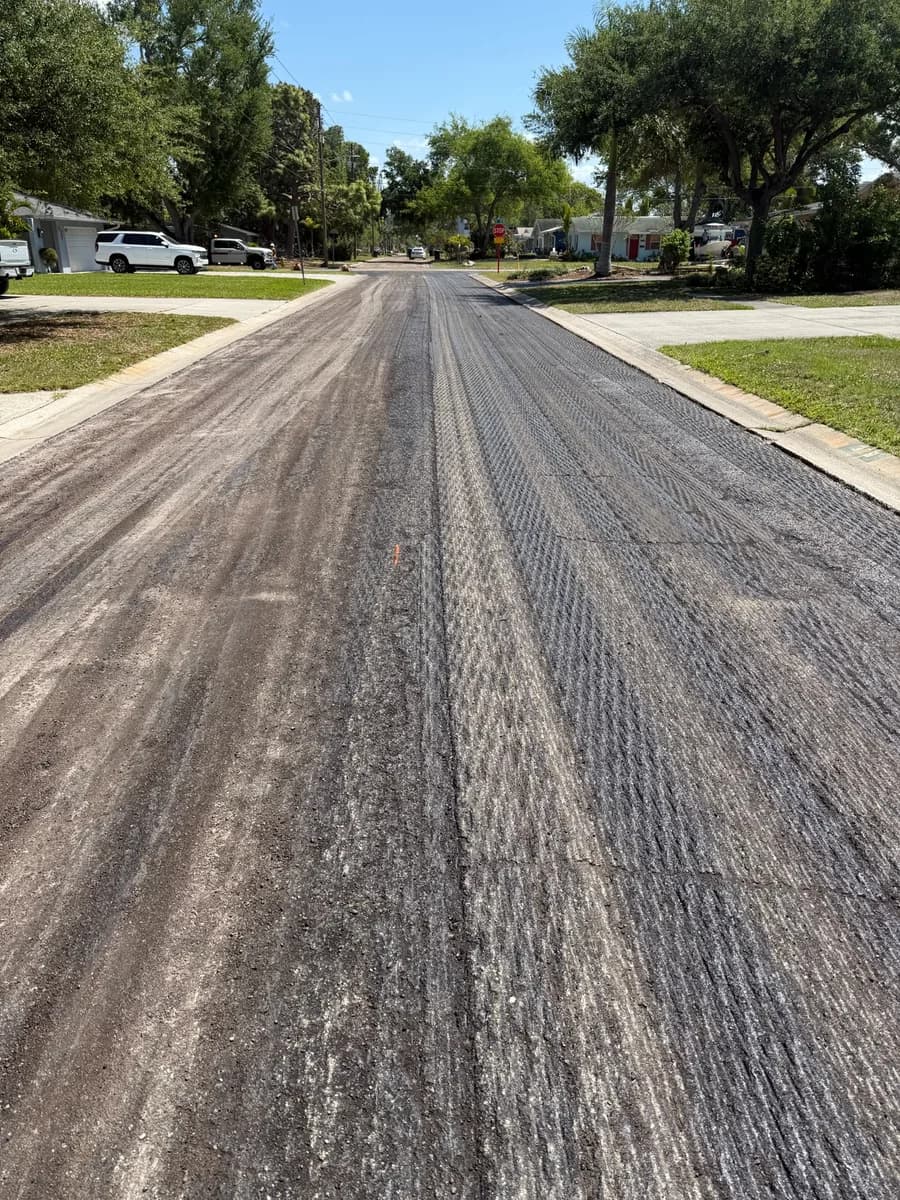
Precision milling is asphalt milling performed to tight tolerances — typically within 1/8 inch of target depth — using advanced grade control systems. It's used when the project requires exact depth control, smooth transitions, or profile correction that standard milling cannot achieve.
The key difference between precision milling and standard milling is the level of control. Precision milling uses string-line references, sonic sensors, or 3D machine control to maintain exact depth and cross-slope specifications. The result is a surface that meets engineering tolerances for smoothness and grade.
In commercial applications, precision milling is most commonly used for overlay preparation where curb reveal is critical, for correcting drainage problems through variable-depth milling, and for creating smooth transitions between new and existing pavement at different elevations.
When Is Precision Milling Needed?
- Overlay preparation with tight curb reveal requirements (less than 1/2 inch tolerance)
- Grade correction — variable depth milling to improve drainage
- Profile leveling — removing bumps and dips for a smoother surface
- Transition zones — creating smooth grade changes between adjacent surfaces
- Specification projects — FDOT or municipal work with strict tolerance requirements
- Around drainage structures — matching grades to inlets and catch basins
- Thin-lift overlay preparation — where depth variation would show through the overlay
How Does Precision Milling Work?
Survey & Reference
Grade references are established — string lines, survey points, or 3D model data — that the milling machine will follow during operation.
Machine Calibration
The milling machine's grade control system is calibrated to the reference. Sensors are positioned and verified before production begins.
Test Section
A short test section is milled and measured to verify the machine is achieving target depth and grade before full production.
Production Milling
The machine advances at controlled speed with grade sensors continuously adjusting cutting depth to maintain specification.
Continuous Verification
Depth and grade are checked at regular intervals during production. Any deviations are corrected immediately.
Final Inspection
The completed surface is surveyed to verify it meets project tolerances. A straightedge check confirms smoothness requirements.
Benefits of Precision Milling
Limitations to Consider
Common Misconceptions
Myth: "All milling is precision milling"
Reality: Standard milling uses the existing surface as a reference and maintains consistent depth below that surface. Precision milling uses external references (string lines, GPS) to achieve a specific target elevation regardless of the existing surface.
Myth: "GPS grade control is always more accurate"
Reality: String-line references can achieve tighter tolerances than GPS for short distances. GPS excels on large projects where string lines are impractical. The best method depends on project size and requirements.
Myth: "Precision milling costs twice as much"
Reality: The cost premium for precision milling is typically 15–30% over standard milling, not double. The value is in avoiding problems downstream — a precision-milled surface produces a better overlay with less material waste.
Myth: "You only need precision milling for highways"
Reality: Commercial parking lots benefit from precision milling when curb reveal is critical, drainage correction is needed, or thin overlays are planned. It's about the tolerance requirement, not the project type.
Typical Commercial Applications
What Information Is Needed Before Requesting an Estimate?
Frequently Asked Questions
How precise is precision milling?
With proper grade control, we achieve tolerances of 1/8 inch (3mm) from target depth. This is verified through continuous measurement during production and post-milling survey.
Do you provide survey control?
We can work with your surveyor's control points or establish our own references. For projects requiring engineering-grade tolerances, we recommend the project surveyor provide control.
Is precision milling slower?
Yes — production rates are typically 60–70% of standard milling rates due to the need for continuous grade verification and slower machine speed. The trade-off is a significantly better result.
Can you fix drainage with milling alone?
Variable-depth precision milling can correct minor drainage issues by creating proper cross-slope. However, if the drainage problem is caused by base settlement or design deficiency, milling alone may not be sufficient.
Ready to discuss your precision milling project?
Get a detailed estimate for your milling project. We respond within one business day.