Asphalt Milling
Professional pavement removal with precision depth control
What Is Asphalt Milling?
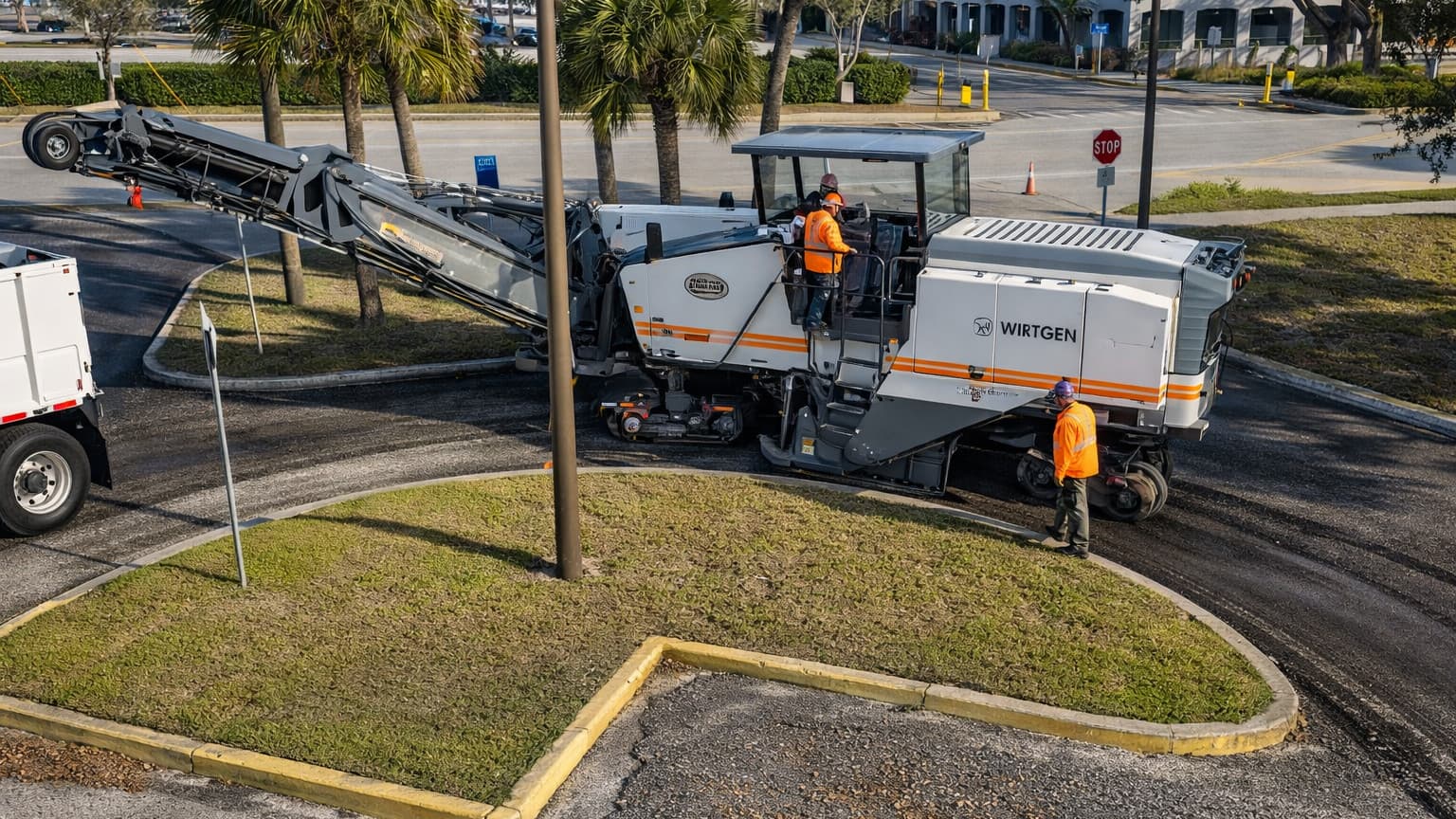
Asphalt milling — also called cold planing or profiling — is the controlled removal of asphalt pavement using a milling machine equipped with a rotating drum studded with carbide cutting teeth. The machine grinds the asphalt surface to a specified depth, loads the removed material (millings) into trucks, and leaves a textured surface ready for overlay or further work.
Milling is a precision operation. Modern milling machines use automated grade and slope controls to maintain consistent depth across the entire cut width. The operator sets the target depth, and the machine's sensors adjust in real time to maintain that depth regardless of surface irregularities.
In commercial applications, milling serves multiple purposes: it removes deteriorated surface material, corrects grade problems, maintains curb reveal for overlay projects, exposes base conditions for inspection, and produces a rough texture that bonds well with new asphalt. The millings themselves are a recyclable material used in new asphalt production.
When Is Asphalt Milling Needed?
- Before overlay — to maintain curb reveal and drainage grades when adding new asphalt
- Surface deterioration — removing oxidized, cracked, or raveled surface layer
- Grade correction — adjusting pavement elevation to improve drainage or match adjacent surfaces
- Full-depth removal — taking pavement down to base for reconstruction projects
- Utility work — removing pavement over utility trenches for access and replacement
- Transition matching — creating smooth transitions between new and existing pavement
- Pavement investigation — exposing base conditions to assess structural integrity
How Does Asphalt Milling Work?
Project Assessment
We evaluate the site to determine milling depth, identify utility conflicts, plan traffic control, and establish the milling sequence for efficient production.
Mobilization & Setup
Milling machine, sweeper, and haul trucks are positioned. Traffic control is established. Reference grades are set for automated depth control.
Milling Operation
The milling machine advances at controlled speed, cutting to specified depth. The conveyor loads millings directly into haul trucks. Water spray controls dust.
Sweeping & Cleanup
A mechanical broom follows the milling machine to remove loose material and debris from the milled surface.
Quality Verification
Depth is verified at regular intervals. Surface texture, grade, and transitions are inspected. Any areas requiring additional passes are identified.
Material Hauling
Millings are transported to a recycling facility or stockpile location. Haul routes are maintained to minimize impact on adjacent traffic.
Benefits of Asphalt Milling
Limitations to Consider
Common Misconceptions
Myth: "Milling is just grinding up the road"
Reality: Milling is a precision operation with automated depth control, grade sensors, and engineered cutting patterns. The result is a controlled surface at exact specifications — not random removal.
Myth: "Any excavator can do what a milling machine does"
Reality: Milling machines produce a uniform, textured surface at controlled depth. Excavation produces an irregular surface that requires additional preparation. They serve different purposes.
Myth: "Millings are waste material"
Reality: Reclaimed asphalt pavement (RAP) is a valuable commodity used in new asphalt production. Millings are routinely incorporated into new mix designs, reducing both cost and environmental impact.
Myth: "You always mill the entire area"
Reality: Milling can be targeted — specific lanes, specific depths, specific areas. We commonly mill only drive aisles or only areas with elevation constraints, leaving other areas for direct overlay.
Typical Commercial Applications
What Information Is Needed Before Requesting an Estimate?
Frequently Asked Questions
How deep can you mill?
Our equipment can mill from 1 inch to full pavement depth (typically 4–8 inches) in a single pass depending on machine configuration. Deeper removal may require multiple passes. The depth is determined by project requirements.
How much area can you mill in a day?
Production rates depend on milling depth, material hardness, and site constraints. A typical commercial project produces 3,000–8,000 square yards per day at 2-inch depth. We provide production estimates during the proposal phase.
What happens to the millings?
Millings are transported to an asphalt recycling facility where they're processed into reclaimed asphalt pavement (RAP) for use in new mixes. If you prefer, millings can also be used on-site for temporary surfaces or base material.
Can you mill around manholes and utilities?
Yes. We hand-mill or use smaller equipment around utility structures. Manholes, valve boxes, and drainage inlets are protected during milling and adjusted to final grade after overlay.
How soon after milling should the overlay be placed?
Ideally within 24–48 hours. The milled surface should not be exposed to traffic or weather for extended periods. For larger projects, we coordinate milling and paving crews to work in sequence.
Ready to discuss your asphalt milling project?
Get a detailed estimate for your milling project. We respond within one business day.